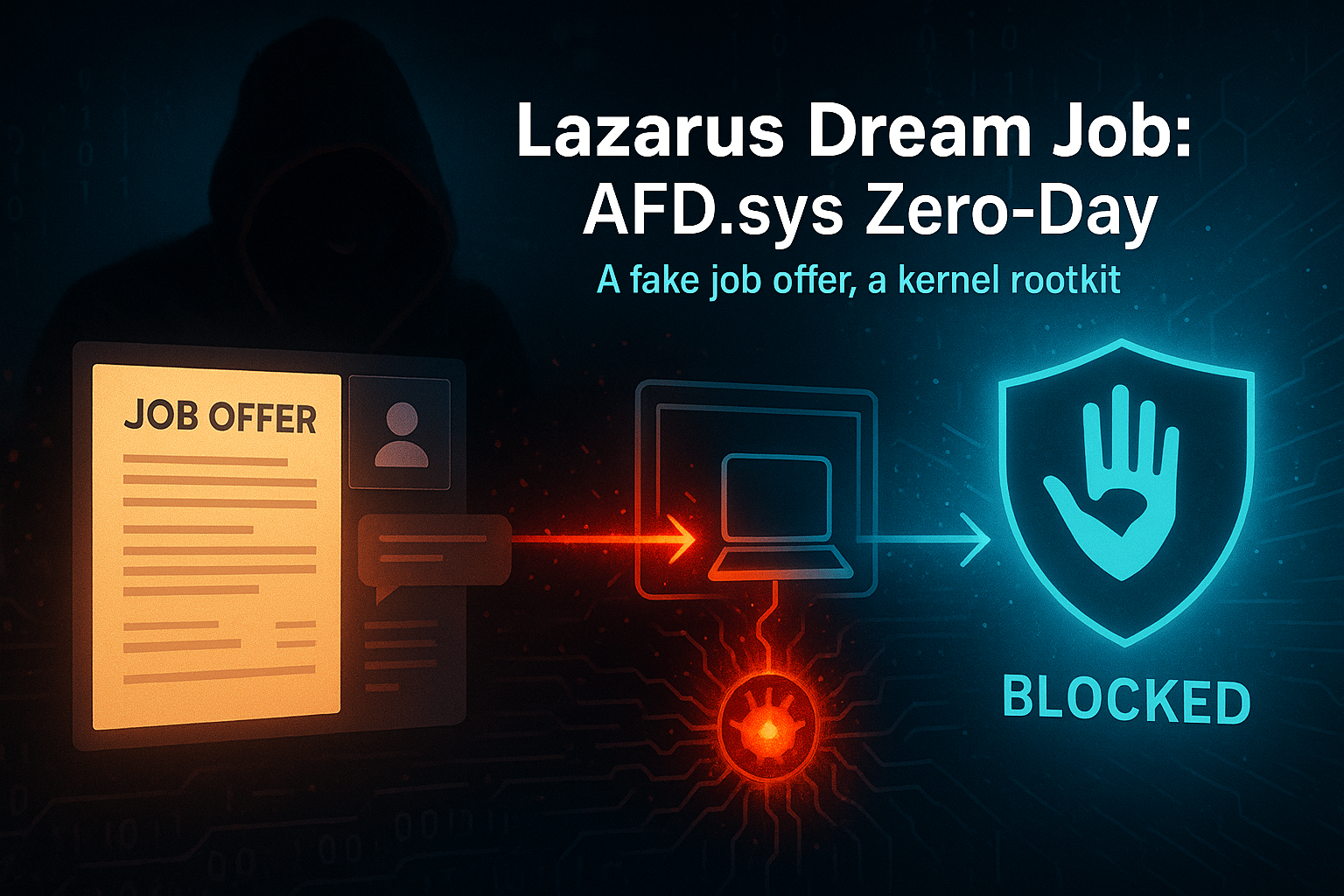
Lazarus Turns a Fake Job Offer into a Windows Kernel Zero-Day: Operation Dream Job and CVE-2026-68820
A recruiter lure, a sideloaded PDF library, and an AFD.sys race condition that hands North Korean operators SYSTEM and a kernel rootkit, and where default-deny execution control does and does not break the chain
Date: August 11, 2026 Primary Source: Check Point Research · SecurityWeek
Executive Summary
- What: Check Point Research reports that the North Korea-linked Lazarus Group exploited CVE-2026-68820, a use-after-free race condition in the Windows Ancillary Function Driver for WinSock (AFD.sys), as a zero-day in a new wave of its Operation Dream Job fake-recruiter campaign. The exploit escalates to SYSTEM and loads the FudModule kernel rootkit, then the ForestTiger backdoor. (Check Point Research)
- Who is affected: Windows systems missing the August 11, 2026 security updates. The campaign targeted defense, aerospace, and aviation organizations in France, Germany, India, and Brazil. (Check Point Research) (The Hacker News)
- Severity: High. CVSS 7.0, local elevation of privilege, exploited in the wild before a patch existed. (The Hacker News) (SecurityWeek)
- Action required: Deploy the August 2026 Windows cumulative updates everywhere, starting with engineering and business-development staff who handle recruiter contact.
- The honest scope note: White Cloud Security doesn't patch AFD.sys, and it doesn't stop an in-memory exploit or a kernel rootkit once attacker code is already running. Where it fits is the entry point: the attack only starts if a victim can launch an unapproved PDF viewer, a sideloaded DLL, or a dropped executable.
Overview
On August 11, 2026, the same day Microsoft shipped its August Patch Tuesday fixes, Check Point Research published "Shattering the Dream – When a Job Offer Becomes a Zero-Day Attack." The report describes a Lazarus campaign it has tracked since early 2026. It targets employees at defense and aerospace firms, especially those working on surveillance sensors, drones, and robotics. (Check Point Research) (BleepingComputer)
Check Point reported the kernel bug to Microsoft on July 28. Microsoft confirmed it on July 31, assigned CVE-2026-68820 on August 5, and patched it on August 11. (Check Point Research) Microsoft says attackers were already using it to elevate to SYSTEM. (SecurityWeek) (Help Net Security) According to The Hacker News, Check Point was aware of a successful use of the exploit in the beginning of June. (The Hacker News)
The social engineering is the part that makes this campaign work. Victims are most likely approached on professional networking platforms such as LinkedIn, or through messaging apps. They receive a "job description" that impersonates a real company, such as Lockheed Martin in one case and the privacy-technology firm Enveil in another. (Check Point Research) (The Hacker News) In one case, Lazarus compromised a French organization and used it to send further spear-phishing. It also exploited Roundcube webmail servers (CVE-2025-49113) and planted a PHP webshell called RelayShell to relay command-and-control traffic. (BleepingComputer) As Check Point's Sergey Shykevich put it: "When the website, the download and the recruiter all appear authentic, the old advice to 'spot the phishing link' is no longer easily applicable." (The Hacker News)
Threat Summary
| Field | Detail |
|---|---|
| CVE ID | CVE-2026-68820 |
| CVSS Score | 7.0 (High) (The Hacker News) |
| Weakness | Use-after-free triggered by a race condition in AFD.sys socket handling (Check Point Research) |
| Affected component | Windows Ancillary Function Driver for WinSock (afd.sys), a kernel-mode driver (SecurityWeek) |
| Observed exploit targets | Windows 11 builds 26100 (24H2) and 26200 (25H2) (Check Point Research) (BleepingComputer) |
| Attack vector | Local — "a locally authenticated attacker could run a specially crafted application," no user interaction required (Help Net Security) |
| Exploited in the wild | Yes — confirmed by Microsoft (SecurityWeek); exploitation known since early June 2026 (The Hacker News) |
| Patch available | Yes — August 11, 2026 Patch Tuesday (Check Point Research) |
| Attribution | Lazarus Group (DPRK), Operation Dream Job (Check Point Research) |
| Malware | MISTPEN, FudModule 3.1, ForestTiger, Troy, RelayShell (The Hacker News) |
Technical Analysis
How the Attack Works
Check Point documented two entry chains that converge on the same goal: attacker code in memory, then SYSTEM. (Check Point Research)
Chain 1: DLL sideloading
- Lure delivery (T1566, Phishing; T1204.002, User Execution: Malicious File). The victim receives an encrypted ZIP containing a legitimate, digitally signed PDF viewer based on MuPDF, a malicious
libmupdf.dll, and an encrypted payload with a.pdfextension. (Check Point Research) - Sideload (T1574.002, DLL Side-Loading). When the victim opens the viewer, it loads the attacker's
libmupdf.dllfrom the same folder. The DLL shows a decoy job description impersonating Lockheed Martin while it decrypts the embedded payload and runs it in memory. (Check Point Research) - MISTPEN. The in-memory downloader uses the Microsoft Graph API and OneDrive for command and control. It pulls down modules for host reconnaissance, process listing, screenshots, and an LPE loader. (Check Point Research)
- Privilege escalation (T1068, Exploitation for Privilege Escalation). The LPE loader, running as an in-memory module, exploits the AFD.sys race condition to build a kernel read/write primitive and gain SYSTEM. (Check Point Research)
- FudModule 3.1 (T1014, Rootkit). The rootkit is decrypted and executed directly in memory. It removes kernel telemetry callbacks and minifilters, suppresses crash dumps, kills 94 ETW providers, and tampers with Windows Smart App Control by setting
VerifiedAndReputablePolicyStateto zero. (Check Point Research) - ForestTiger backdoor. The final remote-access implant is deployed with SYSTEM privileges. (Check Point Research)
Chain 2: the trojanized "SecurityPDF" viewer
- Lookalike download (T1608.006, SEO Poisoning; T1036, Masquerading). Three Enveil impersonation websites appeared in top search results for "Enveil SecurityPDF." Victims download SecurityPDF, a trojanized MuPDF-based viewer. (Check Point Research)
- Marker check and decryption. The viewer looks for a marker string in the "encrypted" PDF, decrypts the embedded payload with single-byte XOR, writes it to
%TEMP%\new.exe, and launches it as a child process. (Check Point Research) - Troy backdoor.
new.exereflectively loads Troy, a 64-bit DLL backdoor with 17 operator commands, including file transfer, process control, an interactive shell, and in-memory DLL injection. (Check Point Research)
Payload and Impact
The end state is a SYSTEM-level backdoor on an engineer's workstation, sitting under a rootkit built specifically to blind endpoint security telemetry. For a defense contractor, that means likely theft of design data, export-controlled technical documents, and credentials into partner networks. Operation Dream Job has always been an espionage and intellectual-property campaign. Check Point also identified at least 17 servers infected with RelayShell that serve as relay infrastructure. (BleepingComputer)
Why Traditional Defenses Struggle
- The lure is believable. A real company name, a plausible role, a lookalike website that ranks in search, and a "secure PDF viewer" that fits the story. User training helps, but a careful employee can still open this.
- The first executable is legitimately signed. In Chain 1, the process the user launches is a genuine signed PDF viewer. Reputation checks and signature-based scanning see a clean binary. The malicious code lives in a DLL the clean binary loads.
- The later stages never touch disk as executables. MISTPEN, the LPE loader, and FudModule all run in memory. Command and control rides on Microsoft Graph and OneDrive, which look like ordinary Microsoft 365 traffic.
- The rootkit targets the detectors. FudModule removes the kernel callbacks and ETW providers that EDR products depend on, and it switches off Smart App Control. (Check Point Research) Detect-and-respond tools that rely on that telemetry are exactly what this stage is designed to blind.
- It was a zero-day. For roughly two months before August 11, there was no patch to apply. (The Hacker News)
How White Cloud Security Trust Lockdown Stops This
Two things are true, and leaving out either one would be misleading.
White Cloud Security would not stop the kernel exploit or the rootkit once attacker code is running. The LPE module and FudModule execute in memory, inside a process that's already running, and FudModule operates in the kernel. Application control governs what is allowed to start. It doesn't inspect what an already-running process does in its own memory, and we don't claim it can govern a kernel rootkit after one has loaded. The fix for CVE-2026-68820 is the August patch.
What White Cloud Security governs is the entry point, and every entry point in this campaign is something the victim has to launch.
Least-Privilege Zero-Trust App Firewall
White Cloud Security (WCS) Trust Lockdown™ enforces Default-Deny Zero-Trust Application Control: only applications, libraries, and scripts explicitly approved for an endpoint are permitted to execute. Here is how that maps to the two chains:
| Attack step | White Cloud Security control |
|---|---|
| Lure delivered via LinkedIn, messaging app, or a compromised partner's email | Not covered. Email security, user awareness, and verification of recruiter contacts apply here. |
| Chain 1: victim launches the signed PDF viewer from the ZIP | Denied at execution unless an administrator has approved that viewer for that host. A PDF viewer nobody requested has no handprint entry. |
Chain 1: viewer loads the malicious libmupdf.dll |
Denied at load. Trust Lockdown governs libraries as well as executables. Even if an organization had approved the viewer, the attacker's DLL has a different handprint from any approved library and is not permitted to load. This is the step that breaks the sideload. |
Chain 2: victim runs SecurityPDF.exe downloaded from a lookalike Enveil site |
Denied at execution. An unknown executable from the internet has no handprint entry and no administrator-approved code-signing certificate. |
Chain 2: SecurityPDF.exe writes and launches %TEMP%\new.exe |
Denied at execution. A freshly written file in a temp folder isn't on the approved list, whatever its parent process. |
| MISTPEN, Troy, and the LPE loader running in memory | Not covered. If attacker code is already executing inside a permitted process, application control doesn't govern its in-memory behavior. |
| AFD.sys exploit → SYSTEM; FudModule loaded in the kernel | Not covered. This is a kernel vulnerability. Patch it. |
| Follow-on tools written to disk and launched (additional implants, credential tools, archivers) | Denied at execution on WCS-protected hosts, provided the attacker hasn't already subverted the kernel on that host. |
In this campaign, application control is only useful at the start of the chain. Everything after the first stage runs in memory, and once FudModule runs in the kernel, the attacker is operating below the level that user-mode and most kernel-mode security controls assume they control. Default-deny is valuable here because it acts at steps 1 and 2, before any of that happens.
Handprint Identity
White Cloud Security identifies files by handprint, a combination of SHA-1, SHA-256, SHA-512, MD5, CRC32, and file length, not by filename, folder, or how legitimate a file looks. That matters twice here. A malicious libmupdf.dll carries the same name as the real library, but its handprint doesn't match anything approved. And SecurityPDF.exe may look like a professional product, but a lookalike website can't make it approved. Legitimate software your users need is approved through Trust Profiles built on administrator-approved code-signing certificates, so updates to approved software don't need a new approval each time. An attacker's own certificate, or an unfamiliar vendor's, isn't on that list unless an administrator puts it there.
At White Cloud Security, we continue to track and report new hacking methods and tools — not just because of its immediate threat, but because patterns of reuse often expose the playbooks of these cybercriminal groups.
Operation Dream Job is a clear example of that. Sideloading a DLL next to a legitimate signed binary and trojanizing an open-source PDF viewer are techniques Lazarus has reused for years, and both depend on a victim being able to run software the organization never approved.
To state the limit plainly: this is prevention at the front door, not protection against a kernel exploit. If attacker code reaches memory some other way, such as through a browser exploit or an approved application with its own vulnerability, White Cloud Security doesn't stop the AFD.sys exploit or FudModule. Application control doesn't replace patching, EDR, email and identity security, network monitoring, or backups. It removes the most common way this campaign gets started: an employee running a file they were sent.
Recommended Mitigations
- Patch now. Apply the August 11, 2026 Windows security updates that fix CVE-2026-68820, and verify installation on engineering and executive workstations first. (Help Net Security)
- Enforce default-deny application control covering executables and DLLs, so a signed viewer carrying a sideloaded library, or a downloaded "secure PDF" tool, can't run.
- Patch Roundcube (CVE-2025-49113) and audit public web servers for unexpected PHP files. Lazarus used compromised Roundcube, WordPress, and SharePoint servers as relay infrastructure. (BleepingComputer) (The Hacker News)
- Brief high-risk staff. Engineers, program managers, and business-development staff at defense and aerospace firms should treat any unsolicited job offer that includes an archive, a special viewer, or a password-protected file as hostile.
- Hunt for Graph API abuse. Look for unusual OneDrive or Microsoft Graph traffic from processes that shouldn't be making it, such as a PDF viewer.
- Assume telemetry gaps on suspected hosts. Because FudModule removes EDR callbacks, reimage any host with a confirmed infection rather than trusting a clean scan.
Indicators of Compromise
The following indicators are published by Check Point Research. This is a partial list; see the full report for all hashes and the YARA rule. (Check Point Research)
Domains
envell[.]xyzenveil[.]onlineuxtramine[.]org
IP addresses
135.181.67[.]203135.181.185[.]158
SHA-256 hashes
| Family | SHA-256 |
|---|---|
| MISTPEN | 2db25ac41a66aa523c79e23e00443573530dd7bd82b8371bcc87bd7232e141eb |
| MISTPEN | 5278ee922838352f1480a73e971161017d643a80b7ec22bf725897dfd088696d |
| FudModule | 3b6378df8442e63a6ed7317075913e4720847a510d95022d4a8347b2637c245d |
| ForestTiger | 72dccae85e062f541fecad9ec7a18a3123e7ae5ac5d53c91709b53a46dbbd289 |
| SecurityPDF.exe | 743172aab606974b054a64561534ae66baa3a840657f79d7c6fa18350e8d45d1 |
| SecurityPDF.exe | db3d69b7eeda2e35e23006bf4b7e206281fce809584207214fc213f9bc30376d |
| Troy | 590fb6ae19480d694e08ee85859cad8066f2f87e7e5abba2960c6d115e1615d6 |
| DLL loader/dropper | 2b4987c07a3d9a9a5d1a9bf4efa3d1903e775090b611710edafdc92874265ca8 |
| RelayShell | 21c3ad4838c4324bc5f081021da5fb2e9073d0c9304087811c21eb47c9e22762 |
Key Takeaways
- CVE-2026-68820 was exploited as a zero-day by Lazarus from at least early June 2026 and patched on August 11, 2026. (The Hacker News) (Check Point Research)
- The attack starts with something the victim runs: a signed PDF viewer with a sideloaded
libmupdf.dll, or a trojanized "SecurityPDF" from a lookalike site. - Everything after the first stage is in memory, and FudModule targets the kernel telemetry that EDR depends on. (Check Point Research)
- No endpoint product, White Cloud Security included, governs a kernel rootkit once it is running. The fix for the vulnerability is the patch.
- Default-deny control of executables and libraries would help block both entry chains before MISTPEN or Troy ever reaches memory.
References
- Check Point Research — "Shattering the Dream – When a Job Offer Becomes a Zero-Day Attack," August 11, 2026
- The Hacker News — "Lazarus Exploits Windows Zero-Day to Gain SYSTEM Access and Deploy Backdoor," August 12, 2026
- BleepingComputer — "Lazarus hackers exploited Windows zero-day to target defense firms," August 12, 2026
- SecurityWeek — "August 2026 Patch Tuesday: Microsoft Fixes 421 CVEs, One Exploited Zero-Day," August 11, 2026
- Help Net Security — "Microsoft patches 400+ vulnerabilities, one zero-day under attack (CVE-2026-68820)," August 12, 2026
- Microsoft Security Response Center — CVE-2026-68820
Further Reading
- The Job Interview That Installs a Backdoor: Sandworm's Trojanized WireGuard "SopraVPN"
- When a "Zoom Installer" Is Not Zoom
- Axios npm Supply Chain Attack: Why Default-Deny Execution Control Matters
- Microsoft Defender RoguePlanet Zero-Day: When SYSTEM Privileges Are Not Enough to Bypass White Cloud Security
- SharePoint CVE-2026-65660: The "Spoofing" Bug That Turned Out to Be Remote Code Execution
Microsoft, Windows, OneDrive, and Smart App Control are trademarks of Microsoft Corporation. Lockheed Martin and Enveil are named only because attackers impersonated them in this campaign. Microsoft, Check Point, Lockheed Martin, and Enveil are not affiliated with, and do not endorse, White Cloud Security, Inc. Technical details of CVE-2026-68820 and the malware described are drawn from the sources linked above. Trust Lockdown™ is a trademark of White Cloud Security, Inc.