The Job Interview That Installs a Backdoor: Sandworm's Trojanized WireGuard "SopraVPN"
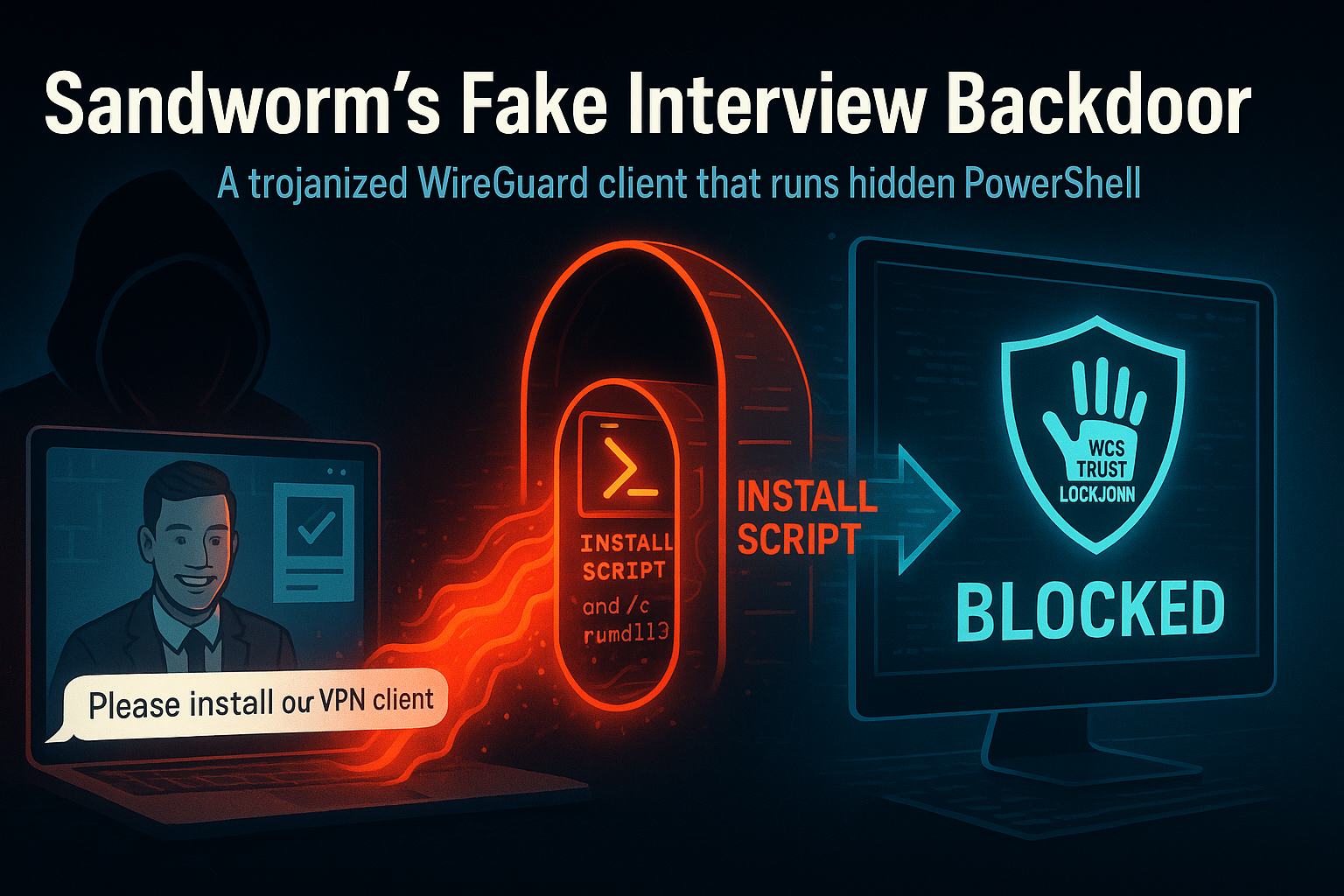
A GRU-linked cluster posed as recruiters, walked system administrators through a fake technical interview, and had them install a rebuilt WireGuard client that runs hidden PowerShell
Date: August 8, 2026 Primary Source: CERT-UA · The Hacker News · BleepingComputer
Executive Summary
- What: CERT-UA reported a social-engineering campaign by UAC-0145, a sub-cluster of UAC-0002 (also tracked as Sandworm, APT44, and Seashell Blizzard). The attackers pose as IT recruiters and run candidates through a staged hiring process. The process ends with a "technical task" that requires installing "SopraVPN," a modified WireGuard client hosted on SourceForge. It decrypts and runs attacker PowerShell hidden inside its configuration file. (CERT-UA)
- Who is affected: System administrators and IT specialists in Ukraine, approached through job-search sites. CERT-UA singles out telecom operators and IT companies. The activity has run since at least May 2026. (CERT-UA)
- Severity: High. No software vulnerability is involved. The target is the person, and the targets are people who hold administrative access. The Hacker News notes that the cluster is affiliated with Russia's GRU. (The Hacker News)
- Action required: Make sure staff know that no legitimate employer requires a VPN client from SourceForge for an interview. Only allow corporate access from managed devices, and search for the listed SourceForge projects, domains, and file hashes. (CERT-UA)
- The honest scope note: White Cloud Security doesn't stop the social engineering, and it only protects devices it's installed on. A job seeker's personal laptop usually isn't one of them. On a managed endpoint, it governs whether a rebuilt, unapproved VPN client, and the payloads it downloads, are permitted to execute.
Overview
CERT-UA published its advisory, "Social engineering by UAC-0145: compromise during the hiring process," on August 8, 2026. The Hacker News and BleepingComputer covered it on August 11, and the Cloud Security Alliance followed with a research note on August 13. (CERT-UA) (The Hacker News) (BleepingComputer) (Cloud Security Alliance)
The scheme works because each step is believable. The attacker reads the candidate's resume first. A recruiter from a real-sounding firm (CERT-UA gives ATLAS Business Group as an example) makes contact through a job site's chat. The conversation moves to Telegram, where an "HR manager" screening for a Sopra Steria Bulgaria project asks about work format and English skills. Then comes a real Zoom interview with an English-speaking man in his early thirties. According to The Hacker News, CERT-UA couldn't say whether he was a real participant or an AI-generated persona. (CERT-UA) (The Hacker News)
By the time the "technical assessment" email arrives, the candidate has been through several convincing steps, and that's the point. The requested download isn't an obvious .exe from a stranger. It's a VPN client, a routine tool for a sysadmin, needed to reach the "corporate" environment for a test. The victims here are Ukrainian. Fake-recruiter lures aimed at technical staff, however, work anywhere people look for jobs, and a sysadmin's laptop is a valuable target anywhere.
Threat Summary
| Field | Detail |
|---|---|
| CVE ID(s) | None. Social engineering and a trojanized open-source client |
| CVSS Score | Not applicable |
| Threat Actor | UAC-0145, a sub-cluster of UAC-0002 / Sandworm / APT44 / Seashell Blizzard (CERT-UA); GRU-affiliated (The Hacker News) |
| Affected Products | Windows and Linux endpoints of IT staff who install "SopraVPN," a rebuilt WireGuard client. WireGuard itself is not vulnerable. |
| Attack Vector | Recruitment lure → Telegram → Zoom → email with WireGuard configs → download from SourceForge (CERT-UA) |
| Exploited in the Wild | Yes. Active since at least May 2026 (CERT-UA) |
| Patch Available | Not applicable. The mitigations are awareness, managed-device access, and application control |
| Impersonated brand | Sopra Steria (Bulgaria) through the look-alike domain soprasteria-bg[.]com. The real domains are soprasteria[.]com and soprasteria[.]bg (CERT-UA) |
Technical Analysis
How the Attack Works
- Recon and approach. The attacker studies the candidate's resume and makes contact through a job site as an IT company recruiter (MITRE ATT&CK T1593, Search Open Websites; T1566.003, Spearphishing via Service). (CERT-UA)
- Build trust. The conversation moves to Telegram for an "HR" screening, then to a live Zoom interview. (CERT-UA)
- Deliver configs. An email from
mike.weitzman@soprasteria-bg[.]combrings "technical interview" instructions, WireGuard configuration files for Windows and Linux, and a second Zoom link to "support" the test. (CERT-UA) - Engineer a failure. Connecting with the supplied configs fails. The configs use a non-standard option and a non-standard key encoding (described below), which the genuine client wouldn't be expected to accept. The "recruiter" then recommends the company's own adapted client, "SopraVPN," linked from a "Corporate VPN on Sourceforge" button on
soprasteria-bg[.]com. (CERT-UA) - Install the trojanized client. SopraVPN is compiled from WireGuard source code with modifications (T1204.002, User Execution: Malicious File). (CERT-UA)
- Decrypt the hidden payload. The modified configuration parser accepts a non-standard
SymmetricKeyoption. It holds Base64-encoded AES-256-GCM data (nonce, ciphertext, and authentication tag), and the key is the 32 bytes decoded from the config's ownPrivateKey(T1027, Obfuscated Files or Information). (CERT-UA) - Hide the keys too.
PrivateKeyandPublicKeyuse a custom Base64 alphabet. The alphabet is shuffled with a Fisher–Yates algorithm, seeded by the CRC32 of theSymmetricKeytext through Go'smath/rand. (CERT-UA) - Execute. The decrypted PowerShell goes to WireGuard's
runScriptCommand, the mechanism that normally runsPostUpcommands. CERT-UA's code comparisons showcmdswapped forpowershell, and the decrypt-and-run step placed ahead of WireGuard'sDropAllPrivilegescall (T1059.001, PowerShell). (CERT-UA) - Stage the next payload. On Windows, the PowerShell creates a scheduled task that downloads an additional payload from the internet (T1053.005). On Linux, it uses cURL to fetch an extra executable from attacker infrastructure through the VPN tunnel, using a DNS server address set in the VPN config. (CERT-UA)
Payload and Impact
CERT-UA describes the downloaded follow-on payloads but doesn't name a malware family. We won't name one either. The host indicators show what the stager does. On Linux, it installs a binary at /usr/libexec/timesyncd-check, a name that blends in with time-sync components. On Windows, it registers a scheduled task under \Microsoft\Windows\ApplicationData\Microsoft, a path that imitates a Microsoft system task folder. (CERT-UA) (Cloud Security Alliance)
The impact comes from who gets infected. The targets are system administrators at IT firms and telecom operators. A compromised administrator workstation can give Sandworm credentials, VPN access, and management-plane reach into the victim's current employer and that employer's customers. That's why CERT-UA recommends allowing corporate access only from managed devices, even personal ones, with protection, policy, and continuous monitoring in place. (CERT-UA)
Why Traditional Defenses Struggle
- It's open-source code with a small change. SopraVPN is real WireGuard with a few functions added. Most of the binary looks like legitimate VPN code, and the malicious logic is a configuration-parsing path.
- The payload is inside the config file. The PowerShell is AES-256-GCM-encrypted in a
.conffile, with keys hidden behind a shuffled Base64 alphabet. Scanning the executable alone won't show it. The Cloud Security Alliance's advice to treat configuration files as content that needs inspection is apt. (Cloud Security Alliance) - The hosting is reputable. SourceForge is a legitimate download site that many filters allow.
- The victim runs it willingly, often with administrator rights. Installing a VPN client is a normal request for a sysadmin, and it needs elevation anyway.
- The tunnel carries the next stage. On Linux, the second payload arrives over the attacker's own VPN tunnel, out of view of the corporate web proxy.
- Personal devices are often unmanaged. Candidates usually job-hunt on personal hardware, where there may be no EDR or policy at all.
How White Cloud Security Trust Lockdown Stops This
Two things are true here, and leaving out either one would be dishonest.
White Cloud Security would not stop the deception. No endpoint control prevents a convincing recruiter, a Telegram chat, or a Zoom interview. And WCS only protects endpoints where it's installed and enforcing. If the candidate is working on an unmanaged personal laptop, application control on corporate machines does nothing for that laptop. It still matters, though, if that laptop later tries to use the stolen access.
What White Cloud Security governs is the moment the lure has to become code. It becomes code at step 5, and again at step 9.
Least-Privilege Zero-Trust App Firewall
White Cloud Security (WCS) Trust Lockdown™ enforces Default-Deny Zero-Trust Application Control. Only applications, libraries, and scripts explicitly approved for an endpoint are permitted to execute.
| Attack step | White Cloud Security control |
|---|---|
| 1–4. Recruiter approach, Telegram screening, Zoom interview, config email, engineered connection failure | Not covered. This is social engineering. Awareness training, verified callbacks, and email and domain controls apply here. |
| 5. User runs the SopraVPN installer or client downloaded from SourceForge | Denied at execution on a WCS-protected endpoint. The rebuilt binary's handprint doesn't match the approved official WireGuard build, and it doesn't carry the code-signing certificate a WireGuard Trust Profile approves. |
| 5a. An administrator approves SopraVPN anyway ("it's just a VPN") | Not covered. An administrator who approves a malicious binary has permitted it. Approval decisions need their own verification. |
6–8. Embedded PowerShell decrypted from SymmetricKey and passed to powershell.exe |
Only covered if PowerShell is restricted. powershell.exe is an approved, signed Microsoft binary. If policy permits it for that user or parent process, an in-memory command line runs. Restricting PowerShell on non-admin systems and using Constrained Language Mode narrow this path. |
| 9a. Windows: scheduled task downloads and launches the follow-on payload | Denied at execution. The downloaded payload has no approved handprint or signer. A scheduled task doesn't make an unapproved file approved. |
9b. Linux: cURL fetches /usr/libexec/timesyncd-check and marks it executable |
Denied at execution on WCS-protected Linux hosts. Setting the execute bit doesn't grant approval. |
| 10. Later tools on the workstation, such as credential theft or remote access | Denied at execution unless they're approved binaries. |
In short, a managed, WCS-protected workstation gives this campaign two separate places to fail. The first is the trojanized client, and the second is the payload it's built to fetch.
Handprint Identity
WireGuard is a good example of why "known software" has to mean a specific approved file, not a product name. SopraVPN is WireGuard in every way a user would notice. It has the same functionality, a plausible name, and a plausible source. White Cloud Security identifies files by handprint: a combination of SHA-1, SHA-256, SHA-512, MD5, CRC32, and file length. A client recompiled from modified source is a new file with a new handprint, and a default-deny policy treats it that way.
Trust Profiles keep legitimate VPN software easy to manage. When an administrator approves the official publisher's code-signing certificate, signed WireGuard releases are permitted without approving each build. An attacker who rebuilds WireGuard from source can't produce that publisher's signature. The trojanized client arrives either unsigned or signed by someone else, and neither matches the approved profile.
At White Cloud Security, we continue to track and report new hacking methods and tools — not just because of its immediate threat, but because patterns of reuse often expose the playbooks of these cybercriminal groups.
To state the limit plainly: White Cloud Security reduces what a successful lure can run. It doesn't make the lure fail. It doesn't stop the social engineering. It doesn't protect an unmanaged personal device. It doesn't stop commands run through an approved PowerShell that your policy permits. And it doesn't override an administrator who approves the malicious client. Application control doesn't replace security awareness, managed-device access policies, MFA, EDR, network segmentation, or backups. It's the layer that decides whether a "technical interview" download becomes a running backdoor on a machine you manage.
Recommended Mitigations
- Brief IT staff and recruiters on this pattern. No legitimate hiring process requires installing a VPN client from SourceForge or connecting to a "corporate" network from a personal device. (Cloud Security Alliance)
- Restrict corporate access to managed devices with protection, policy, and continuous monitoring, including personal devices used for work. (CERT-UA)
- Standardize approved VPN clients. Approve the official WireGuard build by its publisher's signing certificate, and deny everything else.
- Restrict PowerShell on endpoints where it isn't needed, enable script-block logging, and use Constrained Language Mode.
- Inspect WireGuard configs for non-standard fields such as
SymmetricKey. A.conffile with unknown keys is suspicious. (Cloud Security Alliance) - Hunt for scheduled tasks under
\Microsoft\Windows\ApplicationData\Microsoft, for/usr/libexec/timesyncd-check, and for the domains and hashes below. Treat any machine with the client installed as compromised. (CERT-UA) (Cloud Security Alliance) - Enforce Default-Deny application control so that rebuilt clients and downloaded second stages are denied at execution on managed endpoints.
Indicators of Compromise
All indicators below are from CERT-UA's advisory. (CERT-UA)
Files (MD5 / SHA-256)
bf6670760305228fd83a5e1467a99d91/4646ea832a61c9f7bdb11fee64ad82ae6d9856d2f3a4b36a8a4a571145be1260:sopravpn_v7__1_.exed478e96bfb0f3a586c6d17d8bfc874ea/480ab92995295378c9b30b8b6fb61516313ed7482eb893967841b05e233fe341:sopraconf.conf088acb50f7a7e54f887da7b561e18613/22a21958a2c4752214192175793c13acae2f6d766007d55d2140f1570ae1df67:sopraconfLinux.confbe11cc798c239b9d4eaa76ab03d07168/aeb702f65445d12605a84be6fa31545c71be0bf619b1cbedbee5800a43fc6793:SopraVPN.exe676f44c7fa03693247d0dd5c3a0e13f7/6a60152f7c83d3416925316b75eb7720953cdd69aae9f0e088c789c25f51437f:SopraVPN.exe
Network
hxxps://sourceforge[.]net/projects/soprabulgariavpn/files/sopravpn_v10.exe/downloadhxxps://sourceforge[.]net/projects/sopravpn/files/sopravpn_v5.exe/downloadhxxps://sourceforge[.]net/projects/sopravpn/files/sopravpn.exe/downloadhxxps://douncloud[.]site/sitedatastorageadvanced/?subid=%UUID%---%MACHINEGUID%- Domains:
soprasteria-bg[.]com,soprasteriabg[.]com,atlasgroup-ua[.]com,douncloud[.]site udp://139.28.36[.]23:51820(IP139.28.36[.]23)- Email:
mike.weitzman@soprasteria-bg[.]com,alex.boichenkoit@ukr[.]net; Telegram:@Sales_ManagerABG
The Hacker News also lists sourceforge[.]net/projects/soprasteriavpn as a distribution project. (The Hacker News)
Host
/usr/libexec/timesyncd-check- Scheduled task path
\Microsoft\Windows\ApplicationData\Microsoft
Key Takeaways
- Sandworm's UAC-0145 is recruiting sysadmins in order to compromise them. The fake hiring pipeline includes resume research, Telegram, and a live Zoom interview. (CERT-UA)
- The malware is WireGuard with a few functions added. Encrypted PowerShell hides in a non-standard
SymmetricKeyconfig field. (CERT-UA) - The failed connection is engineered. The "fix" is the malicious client.
- Managed-device access policy is the control CERT-UA leads with, because personal laptops are where job hunting happens. (CERT-UA)
- No endpoint product, White Cloud Security included, stops the social engineering or protects a device it isn't installed on.
- On managed endpoints, White Cloud Security would help deny both the rebuilt client and its downloaded payloads. Handprint identity and Trust Profiles distinguish an approved WireGuard build from a recompiled impostor, whatever it's called.
References
- CERT-UA — "Соціальна інженерія у виконанні UAC-0145: компрометація у процесі працевлаштування" (Social engineering by UAC-0145: compromise during the hiring process), August 8, 2026
- The Hacker News — "Russian Threat Group UAC-0145 Weaponizes Fake Job Interviews to Distribute Malicious VPN," August 11, 2026
- BleepingComputer — "Sandworm hackers target IT pros with trojanized WireGuard VPN client," August 11, 2026
- Cloud Security Alliance — "Sandworm's Fake Job Interviews Deliver Trojanized WireGuard VPN," August 13, 2026
Further Reading
- Lazarus Turns a Fake Job Offer into a Windows Kernel Zero-Day: Operation Dream Job and CVE-2026-68820
- When a "Zoom Installer" Is Not Zoom
- When Trusted Tools Turn Malicious: The CPU-Z and HWMonitor Supply Chain Breach
- Notepad++ Supply Chain Attack: Chinese State Hackers Hijacked Software Updates for Months
- Stryker, Shamoon, and the Case for Zero-Trust Least Privilege Software Control
- When Your Own Server Hands Out the Malware: Head Mare Trojanizes TrueConf Client Installers
WireGuard is a registered trademark of Jason A. Donenfeld. Sopra Steria is a trademark of Sopra Steria Group. SourceForge, Telegram, and Zoom are trademarks of their respective owners. None of these parties is affiliated with, or endorses, White Cloud Security, Inc., and none is responsible for the malicious activity described. Sopra Steria's name was impersonated by the attackers. Technical details are drawn from the sources linked above. Trust Lockdown™ is a trademark of White Cloud Security, Inc.