WEL1DROPPER: Hundreds of Slopsquatted npm Packages That Just Want You to Call require()
No install hook, no typosquat of a famous library. Random, AI-plausible package names deliver a native RAT to Windows, macOS, and Linux
Date: August 6, 2026 Primary Source: The Hacker News · OpenSourceMalware
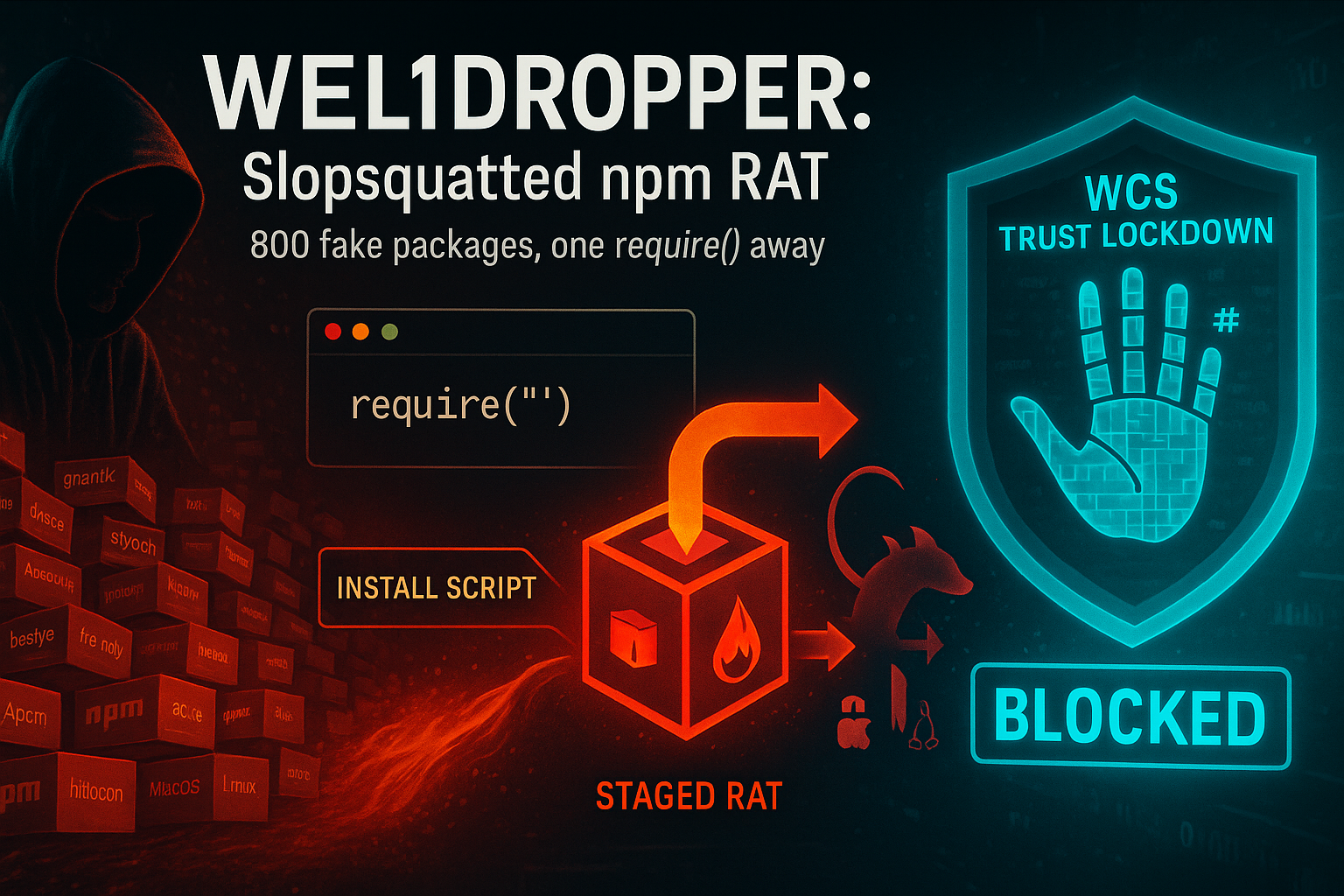
Executive Summary
- What: Between roughly August 3 and 5, 2026, a threat actor flooded the npm registry with close to 800 malicious packages. The packages had random, plausible-sounding names, a pattern researchers call "AI slopsquatting." When a developer loads one with
require(), a downloader tracked as WEL1DROPPER fetches a native remote-access trojan built for the host's operating system and CPU. (The Hacker News) (CSA Labs) - Who is affected: Developers and build systems that installed and imported any of the packages. That includes AI coding assistants and agents that pick dependency names without checking them. OpenSourceMalware first tracked 788 packages. Its co-founder later told The Hacker News the total had reached 1,033 confirmed packages. (OpenSourceMalware) (The Hacker News)
- Severity: High on any machine where a package was imported. The final payloads are native executables with persistence and evasion, reported as a RAT and infostealer. (The Hacker News)
- Action required: Search dependency manifests and lockfiles for the campaign's packages and version pattern (
35.x.y). Rebuild any host that imported one. Verify that a package has a real publishing history before adding it, whether a person or an AI assistant suggested it. (CSA Labs) - The honest scope note: White Cloud Security does not stop the JavaScript downloader, which runs inside an approved
nodeprocess. This campaign fits Default-Deny well anyway, because every payload that matters is a new native binary written to a temp folder under a random name. That is exactly what application control denies at execution.
Overview
Most npm malware reporting this year has focused on install-time lifecycle hooks, where a preinstall or postinstall script runs the moment a package lands. Security teams responded by disabling install scripts. WEL1DROPPER avoids that defense entirely. As OpenSourceMalware put it, the attack triggers through a simple require() call, and "blocking npm lifecycle scripts provides incomplete protection." (OpenSourceMalware)
The naming strategy is the other new element. These packages do not imitate a famous library by one character. They use random, plausible names such as [email protected], the one example OpenSourceMalware names. (OpenSourceMalware) Sonatype, which tracks the campaign as "Flooding Dropper," found that the names reuse terms like "bigops" and "bnpl," cluster in the 35.x.y version range, and come from hundreds of freshly created accounts that each publish only a few packages. (CSA Labs — Flooding Dropper) (The Hacker News) The approach is built for a world where AI assistants suggest dependency names that sound right but may never have existed. An attacker who registers enough plausible names will eventually match one.
The campaign was reported by OpenSourceMalware, Sonatype, and Palo Alto Networks Unit 42. (The Hacker News) References to Russian financial services and the wel1.ru domain suggest a Russian-speaking, financially motivated operator. Researchers suspect it is an evolution of Moika, a dependency-confusion campaign that The Hacker News says was observed in April and published more than 250 packages. The Cloud Security Alliance describes the Russian link as circumstantial. (The Hacker News) (CSA Labs)
Threat Summary
| Field | Detail |
|---|---|
| Campaign / tooling | WEL1DROPPER downloader (OpenSourceMalware); Sonatype name "Flooding Dropper" (The Hacker News) |
| CVE ID(s) | None. These are malicious packages, not a software vulnerability |
| CVSS Score | Not applicable |
| Scale | 788 packages tracked initially; 1,033 confirmed per OpenSourceMalware's co-founder; about 846–850 per Sonatype's count as summarized by CSA (OpenSourceMalware) (The Hacker News) (CSA Labs — Flooding Dropper) |
| Publishing window | About August 3–5, 2026 (CSA Labs) |
| Trigger | require() at import time. No lifecycle hook (OpenSourceMalware) |
| Platforms | Windows, macOS (universal Mach-O), Linux x64 and ARM64 (OpenSourceMalware) |
| Payload | Native RAT and infostealer. The Linux final stage is reported as a Sliver implant (The Hacker News) |
| Exploited in the wild | Yes. Packages were live on the public npm registry |
| Attribution | Suspected Russian-speaking, financially motivated; possible evolution of Moika (circumstantial) (CSA Labs) |
| Remediation | Remove the packages and rebuild affected hosts. No patch applies |
A note on dates: OpenSourceMalware's write-up is dated August 6, 2026. The Hacker News report that brought the campaign to wider attention is dated August 7, 2026. (OpenSourceMalware) (The Hacker News)
Technical Analysis
How the Attack Works
- Publish at volume under random names (MITRE ATT&CK T1195.002, Compromise Software Supply Chain). Hundreds of throwaway accounts each publish a few packages with plausible names in the
35.x.yrange. (CSA Labs — Flooding Dropper) - Get the developer to call
require(). The README tells the reader to load the package withrequire(). There is nopreinstallorpostinstallhook to catch. (The Hacker News) - Run the downloader on import (T1059.007, JavaScript). According to OpenSourceMalware,
index.jscontainstry { require("./_helpers"); } catch (_) {}. The helper calls its ownrun()function as soon as it loads. (OpenSourceMalware) - Hide behind decoy telemetry. An 80 KB
lib/telemetry.jsfile has fake telemetry logic and a second downloader variant. OpenSourceMalware reports that the entry point does not import it and that it "appears intended to add noise" for anyone reviewing the code. Other write-ups describetelemetry.jsas the execution path. The two accounts differ, but either way the downloader lives in JavaScript. (OpenSourceMalware) (CSA Labs) - Fetch a payload for the platform (T1105, Ingress Tool Transfer). The helper checks the OS and CPU architecture. It then downloads
/pkg/package,/pkg/package-arm64,/pkg/loader_mac, or/pkg/package.exefrom three rotating Cloudflare Workers hosts. (OpenSourceMalware) - Fall back to DNS (T1071.004, DNS). If HTTPS delivery fails, the helper rebuilds the binary from Base64 chunks stored in DNS TXT records under
wel1.rusubdomains. (OpenSourceMalware) - Write to temp and launch detached. On Linux and macOS the binary lands at
/var/tmp/.cache_<8 hex>. On Windows it lands at%TEMP%\dotnet_diag_<8 hex>.exe. Either way it runs in the background, detached from the parent. (OpenSourceMalware)
Payload and Impact
What happens next depends on the platform:
- Windows. Sonatype reports that the payload patches Event Tracing for Windows (ETW) and the Antimalware Scan Interface (AMSI) (T1562.001). It sets up persistence through a Registry Run key and a scheduled task (T1547.001, T1053.005), then downloads an encrypted payload,
/pkg/update_win.exe. (The Hacker News) - macOS. The loader checks for debuggers and VMware and installs a LaunchAgent named
com.apple.windowserver.helper.plist(T1543.001). It then downloads a beacon,/pkg/beacon_mac.bin. The macOS payload references Russian financial domainstcsbank.ruandcloudpayments.ru. (OpenSourceMalware) (The Hacker News) - Linux. A UPX-packed ELF downloads more binaries. The final stage is reported as a Sliver implant. OpenSourceMalware notes it has not yet confirmed that attribution itself. (The Hacker News) (OpenSourceMalware)
The business impact is a remote-access foothold on a developer workstation or build server, with the credentials, source code, and signing material those machines usually hold.
Why Traditional Defenses Struggle
- "Disable install scripts" does not help here. The code runs when the package is imported, which the developer does on purpose. (OpenSourceMalware)
- Name-similarity checks miss it. Typosquat detectors compare new names to popular ones. Random plausible names are not close to anything. (CSA Labs)
- The volume overwhelms review. Hundreds of packages from hundreds of accounts, each publishing a few, make account-reputation and takedown efforts a constant chase. (CSA Labs — Flooding Dropper)
- Delivery runs over trusted infrastructure. Cloudflare Workers subdomains and DNS TXT lookups mix in with normal traffic, so domain blocklists stay one step behind.
- The Windows payload blinds its own telemetry. Patching ETW and AMSI is aimed at the tools that rely on seeing behavior after execution. (The Hacker News)
How White Cloud Security Trust Lockdown Stops This
The JavaScript downloader is outside White Cloud Security's reach. The payloads it delivers are exactly what Default-Deny is built for.
Least-Privilege Zero-Trust App Firewall
White Cloud Security (WCS) Trust Lockdown™ enforces Default-Deny Zero-Trust Application Control over applications, libraries, and scripts. Only software that has been explicitly approved is permitted to execute. Here is how that maps to the chain:
| Attack step | White Cloud Security control |
|---|---|
| 1. Slopsquatted packages published to npm | Not covered. This happens on the registry. Dependency vetting is the control. |
2–4. Developer calls require(); _helpers.js runs inside node |
Not covered. This is JavaScript inside an approved interpreter. |
| 5–6. HTTPS or DNS TXT fetch of the native payload | Not covered. Network retrieval by an approved process is not an execution event. |
7. Random-named binary in /var/tmp or %TEMP% tries to launch |
Denied at execution. A newly downloaded file has no approved handprint and no approved signer, so it does not run. |
Windows: ETW/AMSI patching, update_win.exe download |
Not reached on a protected host, because these actions happen inside the denied payload. Any separately launched update_win.exe meets the same deny. |
| Persistence: Run key, scheduled task, LaunchAgent | The entries may be written, but each points to an unapproved binary. Denied at execution at every logon or launch. |
| macOS beacon and Linux Sliver-reported second stage | Denied at execution. Each is another new, unapproved native file. |
Blocking the payload does not undo the import. The helper code still ran, and it can read whatever the node process can read. The cleanup steps below still apply.
Handprint Identity
The campaign generates a fresh random filename for each drop (.cache_<hex>, dotnet_diag_<hex>.exe) and a Windows name made to look like .NET diagnostics. None of that matters to a handprint check. WCS identifies files by SHA-1, SHA-256, SHA-512, MD5, CRC32, and file length, not by name or path. A file named to look like a .NET or Apple component is judged on its content. Trust Profiles approve software through administrator-approved code-signing certificates. An unsigned or unapproved-signer binary gains nothing by landing in a familiar-looking folder.
At White Cloud Security, we continue to track and report new hacking methods and tools — not just because of its immediate threat, but because patterns of reuse often expose the playbooks of these cybercriminal groups.
To state the limit plainly: WCS would help block the native payloads this campaign depends on, but it does not vet npm packages. It does not stop JavaScript running inside an approved node, and it does not stop data being read or sent by that approved interpreter. It does not replace dependency review, registry allowlisting, EDR, MFA, backups, or network segmentation. It is a preventive execution-control layer that complements them.
Recommended Mitigations
- Search manifests and lockfiles for unfamiliar packages in the
35.x.yversion range and for names built from "bigops" or "bnpl." Compare them against the researchers' published package lists. (CSA Labs — Flooding Dropper) - Rebuild, don't clean. Treat any host that imported a campaign package as fully compromised. (CSA Labs)
- Verify every new dependency before adding it, especially names suggested by AI coding tools. Confirm a real publisher, history, and download base. (CSA Labs)
- Monitor imports, not only installs. Extend detection to runtime
require()behavior, such as outbound fetches and child processes spawned bynode. (CSA Labs) - Use a private registry or allowlist for production and build dependencies.
- Enforce Default-Deny application control on developer workstations and self-hosted build agents, so a downloaded native payload cannot launch.
Indicators of Compromise
These are reproduced from the cited research. Consult the original posts for complete package lists.
| Type | Indicator | Source |
|---|---|---|
| Payload hosts | oob-worker.cf103-070.workers[.]dev, oob-worker.cf102-baf.workers[.]dev, oob-worker.cf99-9b3.workers[.]dev |
OpenSourceMalware, The Hacker News |
| macOS beacon proxy | package-proxy.cf5oobworker.workers[.]dev through cf11oobworker |
OpenSourceMalware |
| DNS TXT fallback | wel1[.]ru, dl.wel1[.]ru, sdk.dl.wel1[.]ru, ext.dl.wel1[.]ru, pkg.dl.wel1[.]ru, net.dl.wel1[.]ru |
OpenSourceMalware, CSA Labs |
| Payload URL paths | /pkg/package, /pkg/package-arm64, /pkg/loader_mac, /pkg/package.exe, /pkg/update_win.exe, /pkg/beacon_mac.bin |
OpenSourceMalware, The Hacker News |
| Host artifacts | /var/tmp/.cache_<8 hex>; %TEMP%\dotnet_diag_<8 hex>.exe; ~/.local/share/runtime/com.apple.runtime; LaunchAgent com.apple.windowserver.helper.plist |
OpenSourceMalware |
| SHA-256 (Linux x86-64 payload) | 7e486657f30594afda379b97030252a09a19fe8055e25c9e371544f59bd8e9e3 |
OpenSourceMalware |
| SHA-256 (macOS universal payload) | c214746c74cae8ece8bdaf69aa05da4db6ce013f9e77452d1eed1a002fd9ba00 |
OpenSourceMalware |
SHA-256 (_helpers.js) |
94ef6b1c4a9d31f78f446d053048bcef34fd88f4376a1a46f7f777a9e9c83a29 |
OpenSourceMalware |
SHA-256 (lib/telemetry.js) |
a3e2ffb440b779d30da3ff282affd649731088e8570df7b1aa72742d995b782c |
OpenSourceMalware |
SHA-256 (index.js) |
b74c5675725911c62091bdf40714df760cc2af7a88360d21065f4e1c878aa8f0 |
OpenSourceMalware |
| Example package | [email protected] |
OpenSourceMalware |
The .js file hashes are specific to the sample OpenSourceMalware analyzed. With more than a thousand packages, expect variation.
Key Takeaways
- Turning off install scripts is not enough. WEL1DROPPER runs when a package is imported, so the developer's own
require()starts the infection. (OpenSourceMalware) - Slopsquatting targets how dependencies are chosen now. Random, plausible names are aimed at people and AI assistants who accept a name that sounds right. (CSA Labs)
- The scale is the tactic. 788 packages became 1,033 confirmed, spread across hundreds of throwaway accounts. (The Hacker News)
- The payload is a native binary on all three platforms. That is the point where Default-Deny application control applies.
- White Cloud Security would help block the RAT, not the downloader. Unapproved binaries dropped to temp folders are denied at execution, while JavaScript inside approved
nodestill needs dependency hygiene and monitoring.
References
- The Hacker News — "Nearly 800 Malicious npm Packages Deliver Cross-Platform RAT and Infostealer," August 7, 2026
- OpenSourceMalware — "Russian AI slopsquatting npm campaign" (WEL1DROPPER), August 6, 2026
- Cloud Security Alliance Lab Space — "Slopsquatted npm Packages Deliver RAT and Infostealer at Scale," August 10, 2026
- Cloud Security Alliance Lab Space — "Flooding Dropper: Slop-Squatted npm Packages Deliver RAT," August 11, 2026
Further Reading
- ChainDrop: The keyv npm Worm That Shipped With Valid Provenance
- jscrambler npm Compromise: A Rust Infostealer That Went Looking for Your AI Assistant's Credentials
- Mastra npm Compromise: How WCS Blocks Malicious Payloads Even After a Poisoned Dependency Is Installed
- Axios npm Supply Chain Attack: Why Default-Deny Execution Control Matters
- LiteLLM Supply-Chain Hack: Why AI Infrastructure Needs Default-Deny Protection
npm is a trademark of npm, Inc. Cloudflare and Cloudflare Workers are trademarks of Cloudflare, Inc. Windows is a trademark of Microsoft Corporation; macOS is a trademark of Apple Inc.; Linux is a registered trademark of Linus Torvalds. Sonatype and Unit 42 / Palo Alto Networks are trademarks of their respective owners. None of these organizations is affiliated with, and none endorses, White Cloud Security, Inc. All technical details are drawn from the sources linked above. Trust Lockdown™ is a trademark of White Cloud Security, Inc.